Ease Medical Apparatus And Instruments
An External Fixation Instrument is a medical device system used to stabilize fractured or damaged bones from outside the body. It usually combines pins or wires, connecting rods, clamps, and adjustable frames. These parts create a temporary or long-term support structure around the injured limb. The design may look simple, but every component affects alignment, stability, patient comfort, and healing conditions.
Orthopedic surgeon Dr. Gavriil Ilizarov famously stated, “The more complex the fracture, the more simple the treatment should be.” This principle helps explain why external fixation requires disciplined planning rather than excessive hardware. Surgeons may choose this method when soft-tissue swelling, open wounds, infection risk, or severe bone fragmentation makes internal fixation unsuitable. The frame can permit wound access, gradual correction, or controlled bone movement. It can also support limb reconstruction after major trauma.
Small details matter. Pin placement must respect anatomy, while clamps need secure tightening without damaging the bone. Poor adjustment can cause loosening, discomfort, or unwanted alignment changes. That risk is real.
This article examines how an External Fixation Instrument works, what its main parts do, and where clinical judgment becomes essential. It will also consider cleaning, monitoring, and follow-up requirements. These devices are not automatically better than internal implants. Their value depends on the injury, the patient’s condition, surgical experience, and careful aftercare. Even experienced teams reassess the frame when swelling, pain, or healing progress changes. Mistakes can happen. Reliable treatment therefore combines proven design, hands-on expertise, imaging, and honest review of each patient’s response.
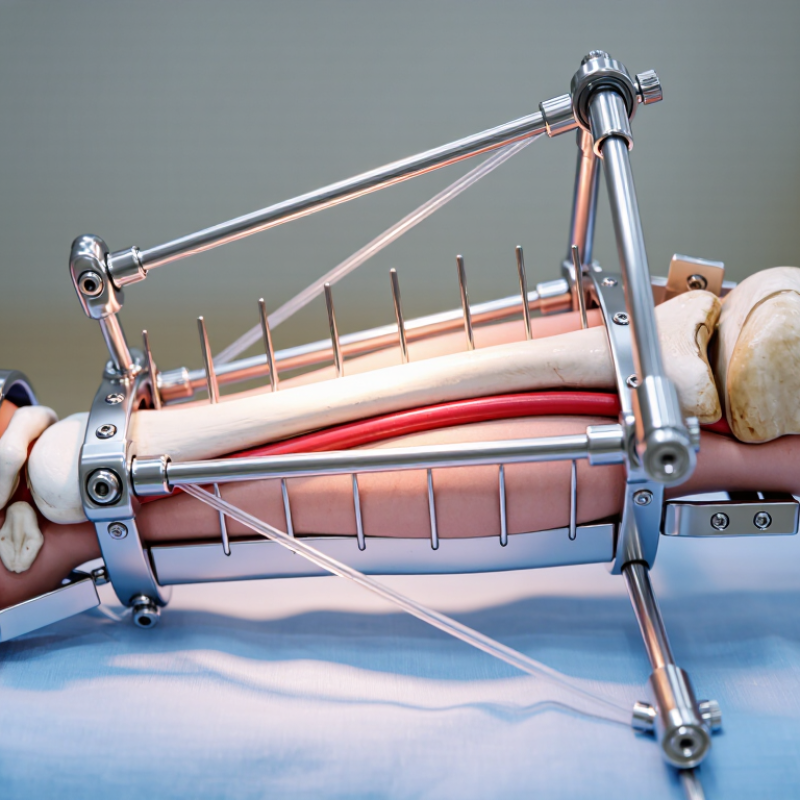
An external fixation instrument is a medical device system that stabilizes a fractured or weakened bone from outside the body. It usually includes fixation pins or wires, connecting rods, and adjustable clamps. Surgeons place the pins through the skin into healthy bone, then attach them to a rigid external frame. This structure holds bone segments in a controlled position while healing begins.
Its main purpose is mechanical support. External fixation can maintain length, alignment, and stability when swelling, open wounds, or complex fractures make internal implants unsuitable. It may also assist with gradual bone lengthening or correction of deformity. The frame leaves injured soft tissue more accessible, which can help with wound inspection and surgical care. However, it is not a universal solution. Patient age, bone quality, circulation, infection risk, and injury pattern all influence the decision.
Clinical teams monitor alignment through examinations and imaging. They also inspect pin sites for redness, drainage, tenderness, or loosening. Small changes can matter. A poorly maintained pin site may develop a serious infection, although careful hygiene and follow-up reduce that risk. Frame adjustments require precision, not guesswork. In practice, even an experienced team may revise the configuration as swelling decreases or healing changes the bone position. The device can look simple, but its safe use depends on planning, surgical skill, and consistent patient care.
What Is an External Fixation Instrument?
An external fixation instrument stabilizes broken or unstable bones outside the body. Its main structure uses bone pins, wires, clamps, connecting rods, and locking joints. Each component has a precise role. Pins transfer load from bone to the frame. Rods create the supporting bridge. Clamps control alignment and hold the assembly firmly.
The frame may be unilateral, circular, or hybrid. A unilateral frame sits beside the limb and allows quick access to wounds. A circular frame uses rings and tensioned wires for multi-directional support. Hinged joints can preserve controlled movement near a joint. The design must balance rigidity with adjustability. Too much flexibility can reduce alignment. Excessive stiffness may restrict useful motion. No frame is perfectly rigid.
Component geometry also affects daily care. Smooth surfaces simplify cleaning. Radiolucent sections improve imaging access. Low-profile clamps may reduce soft-tissue irritation. A 2023 systematic review in Injury reported pin-site infection rates commonly ranging from 10% to 30% across external-fixation studies. That figure shows why pin placement and frame spacing matter, not only mechanical strength. AO Trauma guidance also emphasizes safe anatomical corridors and stable fixation during assembly. In practice, an elegant frame can still become awkward around swelling, dressings, or limited skin access. Engineers and clinicians should keep reassessing the design. The best structure is not always the most complicated one.
What Is an External Fixation Instrument?
How External Fixation Stabilizes Broken Bones
An external fixation instrument supports a broken bone from outside the body. Surgeons place strong pins or wires through healthy bone, then connect them to external rods or rings. This structure holds bone fragments in a controlled position. It can protect damaged skin, swelling, and soft tissue when internal surgery is unsafe.
Alignment matters greatly. The frame limits unwanted movement while new bone begins forming. It also helps maintain length and correct rotation. Doctors check progress with physical examinations and X-rays. Adjustments may be needed as swelling decreases or healing changes the bone position. The device may remain temporarily or support treatment for several months.
Care requires attention every day. Pin sites need cleaning according to the surgical team’s instructions. Increasing redness, drainage, fever, or worsening pain can signal infection. Patients should not change the frame or place weight on the limb without medical guidance. Physical therapy often protects nearby joints from becoming stiff. The frame can feel heavy and awkward. That discomfort is real. Yet stability may allow earlier movement in selected cases. Healing is not always predictable, and even careful treatment can require revision. Regular follow-up helps clinicians respond before a small problem becomes a serious one.
| Data Dimension | Instrument or Feature | How It Works | Typical Clinical Use or Consideration |
|---|---|---|---|
| Definition | External fixation system | Uses pins or wires placed into bone and connected outside the body by rods, clamps, or rings. | Provides temporary or definitive fracture stabilization without placing a large implant directly across the fracture site. |
| Primary purpose | Fracture stabilization | Maintains bone alignment and limits abnormal motion while healing begins. | Particularly useful when soft-tissue swelling or wounds make immediate internal fixation unsuitable. |
| Main components | Bone pins, wires, clamps, connecting rods, and rings | Pins or wires anchor the construct to bone; external connectors join the anchors and create a stable frame. | The frame can be adjusted to improve alignment, stability, or access to the wound. |
| Unilateral frame | Rod-and-clamp frame on one side of the limb | Pins on one side are connected by one or more rods positioned outside the skin. | Often used for rapid stabilization, temporary damage-control treatment, or selected definitive repairs. |
| Circular frame | Rings connected by rods or tensioned wires | Surrounds the limb and distributes corrective forces around the bone. | Can support complex fractures, deformity correction, bone-length procedures, and gradual alignment changes. |
| Hybrid frame | Combination of rings, wires, pins, and rods | Combines the broad support of a ring segment with the simpler fixation of half-pins or rods. | May be selected for periarticular fractures or situations requiring different fixation methods in one construct. |
| Damage-control use | Temporary external frame | Rapidly stabilizes the limb while limiting additional surgical trauma and allowing swelling to decrease. | Commonly considered for severe trauma, open fractures, vascular injury, or significant soft-tissue damage. |
| Open-fracture management | Pin-based stabilization away from the wound when possible | Stabilizes bone while preserving access for irrigation, debridement, wound monitoring, and soft-tissue coverage. | Treatment also requires assessment for contamination, tissue damage, vascular status, and infection risk. |
| Mechanical stabilization | Frame stiffness and pin or wire configuration | Stability depends on factors such as pin spread, pin placement, rod position, frame geometry, and bone quality. | The surgeon selects the configuration according to fracture pattern, anatomy, soft-tissue condition, and expected loading. |
| Joint-spanning frame | Frame crossing a nearby joint | Temporarily holds the limb in a protective position by restricting movement at the injured joint. | May be used for unstable injuries, severe swelling, or fractures close to a joint; later conversion may be considered. |
| Advantages | Minimal implant at the fracture site | Can reduce additional disruption of injured soft tissues and may allow ongoing access to the fracture area. | May be valuable when internal hardware placement is delayed or when the surrounding tissue is compromised. |
| Pin-site care | Routine inspection and cleaning around pins or wires | Helps identify redness, drainage, increasing pain, swelling, or loosening at the skin–pin interface. | Care instructions vary; patients should follow the clinical team’s protocol and report possible infection promptly. |
| Potential complications | Pin-site infection, loosening, malalignment, stiffness, and neurovascular injury | Problems may result from bacterial entry at pin sites, inadequate stability, incorrect alignment, or prolonged joint immobilization. | Regular clinical review and imaging help monitor healing, alignment, frame stability, and limb function. |
| Weight bearing | Activity level determined by fracture and frame stability | External frames can carry some load, but safe loading depends on bone healing, construct design, and the treating surgeon’s instructions. | Patients should not increase weight bearing or adjust frame components without medical guidance. |
| Removal or conversion | Frame removal or transition to another treatment | The frame may be removed after adequate healing or replaced by another fixation method when soft tissues and the patient’s condition permit. | Timing is based on clinical examination, radiographic evidence of healing, stability, and overall treatment goals. |
Note: The choice of external fixation method, frame configuration, activity level, and duration of treatment must be determined by a qualified orthopedic professional.
An external fixation instrument stabilizes broken or unstable bones from outside the body. Metal pins or wires enter the bone through small skin openings. Clamps and connecting rods remain outside the limb. This structure holds bone fragments in position while healing begins. A surgeon selects the frame after reviewing X-rays, soft-tissue damage, and the patient’s general condition.
It can provide temporary stability when internal surgery must wait. The frame leaves injured skin accessible for cleaning, wound treatment, or reconstructive procedures. Doctors may also use it for infected nonunions, bone loss, limb-length differences, and selected deformity corrections. In children, adjustable frames can support gradual growth-related treatment. Every case differs.
Patients usually need scheduled imaging and careful pin-site checks. Redness, warmth, drainage, increasing pain, or fever may signal infection. A loose pin can reduce stability and requires prompt clinical assessment.
Daily movement plans often include nearby joints, unless the care team restricts motion. Walking may be possible with support, but weight-bearing depends on bone strength and frame design.
External frames can feel bulky and inconvenient. That discomfort is real. Treatment decisions are not always perfectly predictable, and healing may take longer than early images suggest. Proper adjustment requires an experienced orthopedic team.
What Is an External Fixation Instrument?
Types, Benefits, and Possible Limitations
An external fixation instrument stabilizes broken or damaged bones from outside the body. It uses metal pins or thin wires placed through the skin and connected to rods, clamps, or rings. These components hold bone fragments in a controlled position while healing begins. Common designs include unilateral frames, circular frames, and hybrid systems. Each type suits different fracture patterns, soft-tissue conditions, and treatment goals.
The main benefit is access to injured skin and muscle. Clinicians can monitor wounds, change dressings, and perform procedures without removing the frame. External fixation also offers useful adjustability. Small corrections may be possible during follow-up visits, guided by physical examination and imaging. It can provide rapid stabilization when swelling or open wounds make internal implants unsuitable. Temporary use is common, although some complex injuries require longer support.
Limitations deserve equal attention. Pin-site infection is a recognized concern. Careful cleaning and regular assessment are essential. Pins can loosen, and the frame may feel heavy, awkward, or painful during daily activities. Joint stiffness and muscle weakness can develop without an appropriate rehabilitation plan. Alignment may change if components are poorly positioned or damaged. It is not a simple “set and forget” treatment. In real clinical care, outcomes depend on surgical technique, patient cooperation, follow-up imaging, and timely management of warning signs such as fever, drainage, increasing pain, or numbness. Even experienced teams must reassess the plan as healing progresses.
External fixation instruments stabilize fractured or deformed bones with pins or wires connected to an external frame. This chart compares characteristic frame elements used in common external fixation designs.
How to read the chart: A value of 1 indicates that the element is a characteristic feature of the frame type, while 0 indicates that it is not typically a defining feature. Actual configurations vary according to the injury, anatomy, and treatment plan.
Clinical context: External fixation can provide rapid stabilization, preserve access to injured soft tissue, and support gradual correction or bone transport. Possible limitations include pin-site infection, discomfort, frame bulk, loosening, neurovascular injury, and the need for careful follow-up and pin care.
It stabilizes broken or unstable bones outside the body. Pins, wires, clamps, rods, and joints form the supporting frame.
Pins or wires connect the bone to rods, rings, or clamps. These parts control alignment while healing begins.
Common designs include unilateral, circular, and hybrid frames. A unilateral frame sits beside the limb. Circular frames provide multi-directional support.
It can stabilize injuries quickly when swelling or open wounds make internal implants unsuitable. Wounds remain accessible for cleaning and dressing changes.
Some frames allow small corrections during follow-up visits. Clinicians may use examination and imaging to reassess alignment.
The frame may feel heavy, awkward, or painful. Dressings and swelling can make access difficult. No frame is perfectly rigid.
Pin-site infection, loose pins, increasing pain, fever, drainage, numbness, and alignment changes require prompt clinical assessment.
Careful cleaning and regular inspection are essential. Safe pin placement and suitable frame spacing also matter. Healing still needs supervision.
Excessive stiffness may limit useful joint movement. Without suitable rehabilitation, joint stiffness and muscle weakness can develop.
No. The plan may need changes as swelling, wounds, alignment, and healing progress. An elegant frame can still become awkward in daily life.
An External Fixation Instrument is a medical device system used to stabilize fractured or damaged bones from outside the body. It typically includes external frames, connecting rods, clamps, and fixation pins or wires that pass through the skin and attach to the bone. By holding bone segments in a controlled position, the system limits unwanted movement, supports alignment, and creates suitable conditions for healing. Its adjustable structure also allows healthcare professionals to monitor the injury and make gradual corrections when necessary.
External fixation may be used for complex fractures, severe soft-tissue injuries, bone lengthening, deformity correction, and temporary stabilization before another procedure. Its benefits can include adjustable support, access to injured tissue, and reduced disruption to the fracture area. However, possible limitations include pin-site infection, discomfort, restricted movement, and the need for careful cleaning and follow-up. The choice of frame and treatment approach depends on the injury, bone condition, and the patient’s overall needs.
